You turn the key or press the button, and instead of the engine roaring to life, you hear a click. Maybe it is one sharp click, maybe it is a rapid clicking like a machine gun, and maybe the lights on the dash flicker or go dim. Either way, the car is going nowhere. A clicking sound when you try to start is one of the most common starting problems, and it is also one of the most informative, because the kind of click often points to the cause. This guide explains what a clicking sound means, the likely causes from a weak battery to a bad starter, what you can safely check yourself, and when to call for help. If you are stuck with a car that clicks but will not start in Oklahoma City, this will help you understand what is going on and what to do next.
What Happens When You Start a Car
Starting an engine takes a lot of electrical power. When you turn the key or press the start button, a signal goes to the starter system. A relay or solenoid closes, sending a heavy current from the battery to the starter motor, which spins the engine until it can run on its own. The click you hear is usually the solenoid or a relay closing. If there is not enough power reaching the starter, or the starter cannot do its job, you may hear a click and nothing more. So a clicking sound tells you the system is trying but something is stopping the engine from turning over.
What the Type of Click Can Tell You
Listen carefully, because the pattern is a clue. It is not a guarantee, but it narrows things down.
- Rapid, repeated clicking, like a fast tick tick tick, often points to a weak or discharged battery, or a poor connection that cannot deliver enough power
- A single loud click and then silence can point to a failing starter, a starter solenoid problem, or a bad connection to the starter
- A faint click or no sound at all, with lights that work, can point to a relay, a switch, or a wiring problem
- A click along with dim or flickering lights suggests low battery power or a loose or corroded connection
- A click along with a grinding or whirring sound can mean the starter is spinning but not engaging properly with the engine
Cause One: A Weak or Dead Battery
This is the most common cause of a clicking, no start. A battery can have enough power to run the lights and radio, but not enough to turn a heavy engine. The solenoid clicks on and off rapidly because the voltage drops as soon as the starter demands current. Signs of a weak battery include slow cranking in the days before, dim headlights, a battery warning light, an age of several years, and a car that has been sitting for a while. Heat and cold both wear batteries down, so a battery that has been through hard seasons is more likely to give up.
Cause Two: Corroded or Loose Battery Terminals
A battery can be healthy and still fail to deliver power if the connection is poor. Crusty white, blue, or green buildup on the terminals, or a clamp that has worked loose, adds resistance and limits the current. The result can be a click with dim lights and no start. Look at the battery terminals, and see whether the clamps are tight and the buildup is heavy. Cleaning and tightening them can sometimes solve the problem, though you should follow safety precautions, described below.
Cause Three: A Failing Starter Motor or Solenoid
If the battery is strong and the connections are good, the starter itself may be at fault. Starters wear out over time. The motor can fail, the solenoid contacts can burn out, or the starter can stick. A common symptom is a single, solid click when you turn the key, with bright lights and good battery power, but no cranking. Sometimes the car starts after a few tries or after a light tap on the starter, then fails again later. That pattern usually means the starter is on its way out and should be replaced. Do not rely on tricks, since a failing starter can leave you stranded without warning.
Cause Four: Bad Cables, Grounds, or Wiring
The heavy cables that carry current from the battery to the starter, and the ground cable that completes the circuit, can corrode, fray, or come loose. A bad ground can cause strange symptoms, including clicking, dimming lights, and intermittent starting. These problems can be hard to see, because corrosion can hide under the insulation, and a technician may need to test the voltage drop to find them.
Cause Five: A Faulty Relay, Fuse, or Ignition Switch
The starting circuit includes relays, fuses, and a switch that tell the starter when to engage. If one of these fails, you may hear a click from the relay itself, or nothing at all. An ignition switch problem can cause a click, or silence, or lights that behave strangely when you turn the key. In some vehicles, a faulty safety switch, such as one that checks the gear position or the clutch, can also stop the starter from working. If your car has a push button start, a weak key fob battery or a security problem can sometimes interfere, and your owner’s manual may describe a backup method.
Cause Six: A Charging System Problem
If the battery keeps going flat, the root cause may be the alternator, which is supposed to recharge it while you drive. A failing alternator can leave the battery drained, and the next time you try to start, you hear clicking. Warning signs include a battery or charging light on the dashboard, dimming lights while driving, and electrical glitches. Replacing the battery without fixing the charging problem will lead to the same result again.
Cause Seven: Engine Mechanical Problems
Less often, the starter and battery are fine, but the engine itself will not turn. That can be due to a seized component, or a problem like hydraulic lock from liquid in a cylinder. A single heavy clunk or click with no movement at all, and a car that feels locked, is a reason to stop trying and have it inspected. Repeatedly cranking can make things worse.
What You Can Safely Check Yourself
- Notice the type of click, and whether the dash lights stay bright, dim, or flicker
- Check whether the headlights and interior lights are strong, and whether they dim sharply when you try to start
- Look at the battery terminals for corrosion and loose clamps
- Check that the car is in park or neutral, as your owner’s manual specifies, and that the brake pedal is pressed if required
- If you have a key fob, try the spare, or follow your manual’s instructions for a weak fob battery
- Look at the dashboard for warning lights or a security light that stays on
Do not keep cranking over and over, since repeated attempts can overheat the starter and drain what is left of the battery. A few short tries with pauses in between is the most you should do.
Can You Jump Start a Car That Clicks?
If the cause is a weak battery, a jump start may get the car going. Follow the steps in your owner’s manual exactly, since the correct method varies by vehicle, and a mistake can damage electronics or cause injury. Some newer vehicles have specific jump points under the hood. If the car does not start with a jump, or it starts and dies again soon after, the battery may be at the end of its life, or there could be a charging or starter problem. If the battery is swollen, cracked, or leaking, do not try to jump it, and get help instead.
Safety Notes
- Wear eye protection and gloves when working near a battery, since it contains acid and can release flammable gas
- Keep sparks, flames, and cigarettes away from the battery
- Do not let metal tools bridge the terminals
- Do not attempt to reach into the engine bay while the engine is turning or could start
- If you are in an unsafe place, such as the side of a busy road, prioritize your safety and call for roadside assistance
- Check your owner’s manual before touching cables or terminals, especially on hybrid or electric vehicles, and leave high voltage components to a professional
How a Technician Finds the Real Cause
The fastest way to solve a clicking, no start is to test, not guess. A technician will typically ask what happened and what you heard, check the battery’s voltage and its ability to deliver current under load, inspect the terminals, cables, and grounds, test the starter and the starting circuit, check the relays and fuses, and test the charging system. Measuring the voltage drop across connections can reveal bad cables that look fine. This approach avoids replacing a good battery when the starter is bad, or the other way around.
What Repairs Usually Involve
The right fix depends on what testing shows. It might be as simple as cleaning and tightening the terminals, or it might involve replacing the battery, a cable, a relay, the starter, or the alternator. If the starter is to blame, replacing it often takes care of the problem, and the technician should also check the charging system, since a weak battery can shorten a starter’s life. After the repair, the car should start strongly, and the charging voltage should be normal.
Other Signs a Car Needs Prompt Attention
A starting problem can be one sign among several. If you have noticed warning lights, strange noises, leaks, or changes in how the car drives, it may be time for a closer look. Our article on signs Oklahoma City drivers need immediate car repair covers warning signs that should not wait, and can help you decide how urgent your situation is.
Can a Mobile Mechanic Fix a Car That Clicks and Won’t Start?
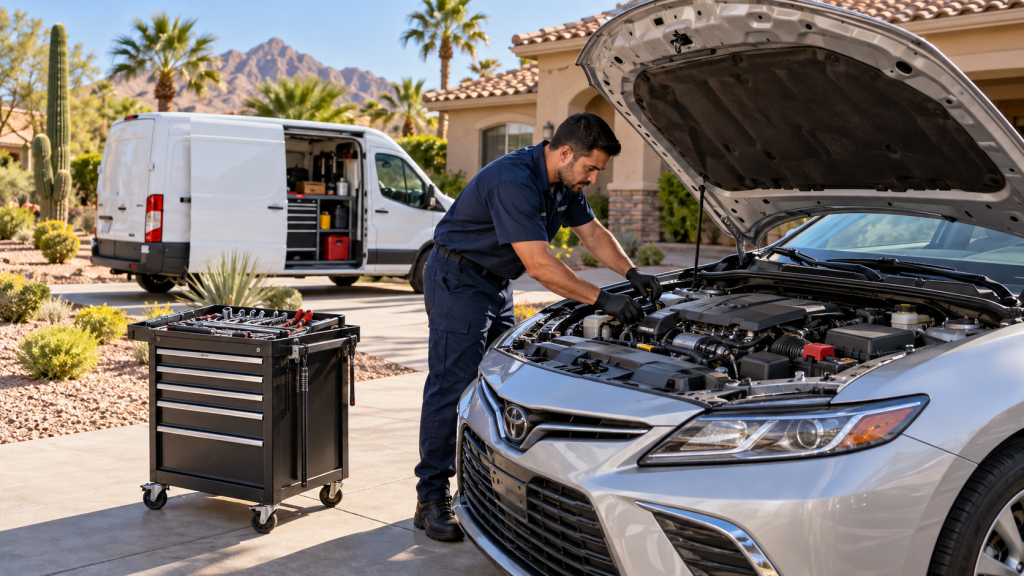
In many cases, yes, and this is one of the most common reasons people call one. A no start car cannot be driven to a shop, and a mobile mechanic can come to you, test the battery, the starter, and the charging system, and handle many common repairs on the spot, such as battery replacement, terminal and cable repair, and starter or alternator replacement on many vehicles. Our article on why mobile mechanics are better than traditional auto shops in Oklahoma City, OK explains the advantages of having the repair come to you. Some starters are in hard to reach spots, and some repairs may need a lift or specialized equipment at a shop, and a trustworthy technician will tell you honestly when that is the case. When you call, describe the click, whether the lights are bright or dim, how long the car sat, and your vehicle’s year, make, model, and mileage.
Do Not Keep Turning the Key
A click is your car telling you where to look. Listen to it, check what you safely can, and stop cranking before you make things worse. A short test usually tells you whether you need a battery, a cable, or a starter, and the sooner it is handled, the sooner you are back on the road.
To learn more about our services, visit our homepage. If your car clicks but will not start, reach out through our contact us page and we will come to you anywhere in the Oklahoma City area.